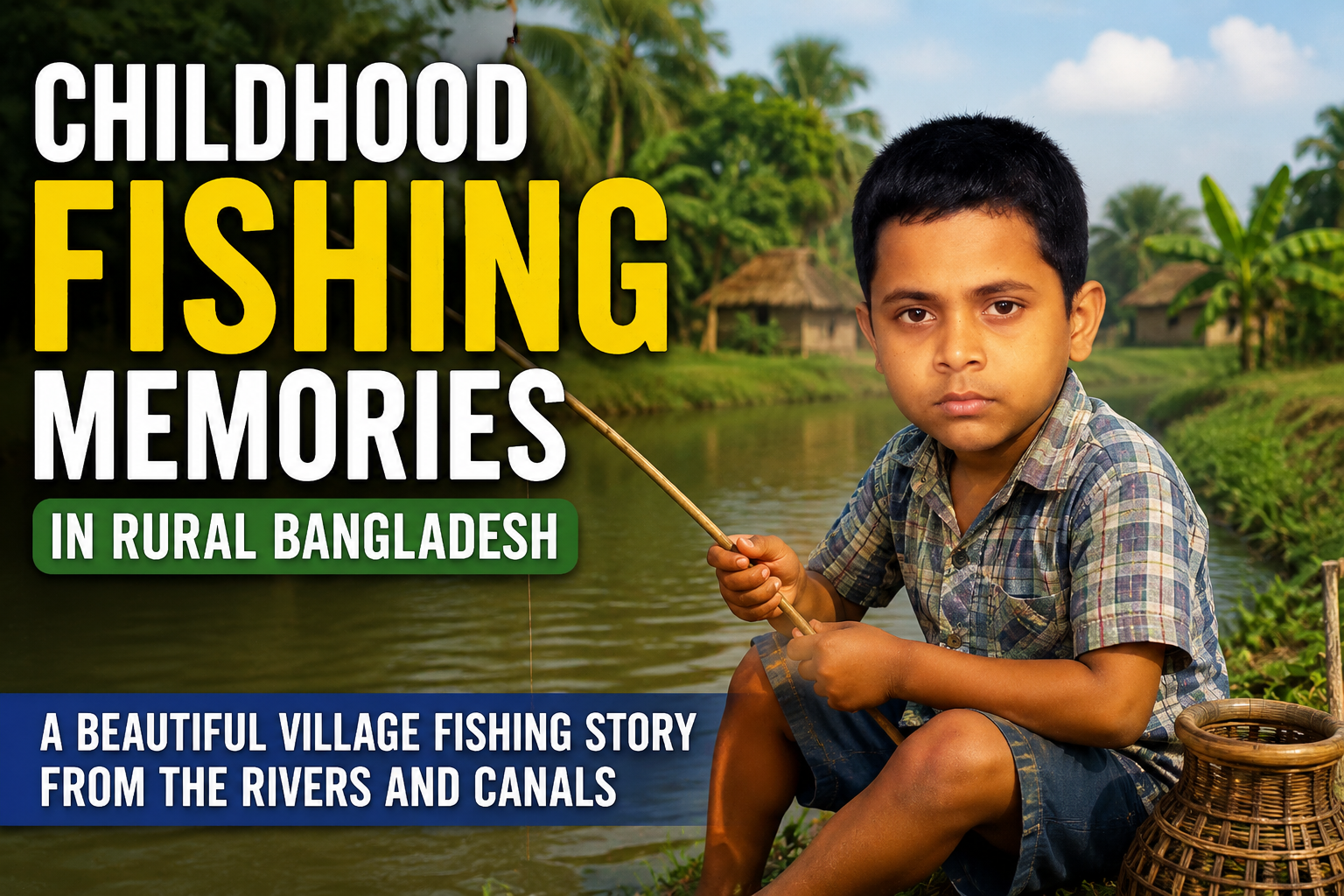
Childhood Fishing Memories in Rural Bangladesh – A Beautiful Village Fishing Story from the Rivers and Canals
childhood fishing memories in rural Bangladesh
With a bag over our shoulder, we stepped down into the flowing water and began our childhood fishing adventure. That was when the friendly competition started—who could catch more fish, who would catch the first one, and who would find the biggest catch of the day. There was laughter, excitement, and endless fun. One of our favorite ways of fishing was carefully reaching our hands into the roots at the base of the Firefly trees, checking one by one to see if fish were hiding there. It had to be done slowly and carefully. The biggest fear was that snakes or crabs could be hiding underwater and might bite us if we were careless. Every single step had to be taken with attention and patience. But even with that fear, standing in the flowing current and searching for fish was one of the most exciting and memorable parts of our village childhood. The fish we usually caught included Katali Prawn, Macrobrachium rude, small Lobsters, Mystus cavasius, and Grey Eel Catfish. Among them, Mystus cavasius and Grey Eel Catfish were the most dangerous to handle. Their sharp fins could cut into our hands if we were not careful. I still clearly remember one particular day. While trying to catch one of those fish, its sharp spine pierced my hand so suddenly that the fish remained hanging from my hand for a moment. It hurt badly, but somehow even that painful moment became part of the adventure. My friends laughed, I laughed, and today that memory still feels special. Looking back now, even the pain carries a strange sweetness. After one or two hours of fishing in the rivers and canals, we would usually collect a large number of fish. Our bags slowly became heavier and fuller. Seeing the fish piling up gave us a feeling of pure happiness and satisfaction that is hard to describe. At other times another competition would begin—catching Labeo bata using a Scoop Net / Hand Net. This traditional village fishing method was more difficult and required patience, skill, and perfect timing. We would hold the scoop net underwater, keep our entire body beneath the surface, and leave only our eyes above the water. Then, very quietly and carefully, we would swim toward a school of fish. We had to stay silent and steady so the fish would not notice us. When the fish came directly above the scoop net, we had to quickly lift the net upward in one fast motion. In that very moment, the Labeo bata would get trapped inside the net. Then everyone would shout with joy, laugh together, and celebrate the catch. Those moments were filled with pure excitement and unforgettable childhood happiness. Those village fishing days were simple, natural, and deeply joyful. There was no rush, no stress, and no pressure. There was only nature around us, flowing water touching our feet, birds calling from the trees, friends laughing beside us, and the excitement of catching fish in the rivers and canals of rural Bangladesh. When fishing was finished, we all walked back home together with happy hearts. On the way home we talked about who caught the most fish, whose bag was the heaviest, and replayed every exciting moment again and again. Reaching home and proudly showing the fish we had caught brought another level of happiness. Today, many things have changed. The rivers, canals, trees, flowing water, and those peaceful childhood days of village life now live mostly in memory. Time has moved on, and life has become much busier. But whenever the mind feels tired, I remember those childhood fishing memories in rural Bangladesh—the rivers and canals, the flowing water, the village trees, the laughter of friends, the traditional fishing methods, and the simple joy of catching fish with our own hands. And every time I remember those days, my heart feels peaceful again. Truly, the childhood fishing days in the villages of Bangladesh remain one of the most beautiful, unforgettable, and valuable memories of my life. Writer: Md. Nasir Village fishing story. Traditional fishing. Fishing in rivers and canals. Childhood village memories. Rural Bangladesh fishing experience Fishing with hand net. Bangladesh river fishing memories Traditional fish catching in village Childhood memories of fishing. Village canal fishing storyComments (0)
Sign in to like, comment or create a tracked share link. Log in with your registered account to earn reward points for eligible activities and post comments.
Login
Related Posts
Winter Morning and Evening Memories: A Lost Sweet Tradition of Rural Life
Memories from the past never truly fade; instead, they grow warmer and more meaningful with time. Among those cherished ...

There is no age for learning: Is it possible to be successful even if you start late?
There is no age limit for learning. Even if you start late, it is possible to change your life if you have the desire an ...
.jpeg)
Study or Love? Why the right decision is most important in student life.
Love may come in student life, but that is not the end of life. This article is about why education is the strongest fou ...
Memories of My Maternal Grandfather’s Home: Freedom, Rivers, and Childhood Joy
Introduction Childhood is made of places, people, and emotions that grow stronger with time. For me, that place was m ...

Sharif Osman Hadi: A Voice Silenced, A Conscience Awakened
Sharif Osman Hadi, spokesperson and leading figure of Inkilab Mancha, was more than a political activist — he was a fear ...